

After a month of continuous protests through art performances, activists and Amis Aborigines at Shanyuan Bay (杉原灣), Taitung County, who oppose the construction of a beachfront Meiliwan Resort Hotel gathered by the thousands again yesterday for a ritual ceremony at the beach.
The “besiege and fence” project by artists and activists to protest against the build-operate--transfer project was launched on June 10, followed by sit-ins and performances during the following month.
The Taitung County Government is suspected of illegally segmenting the land to avoid the need for an environmental impact assessment. After being sued by local residents and with a court ruling last year ordering a halt to construction, the county government -nevertheless authorized construction and issued licenses to the developer.

Photo: Chang Tsun-wei, Taipei Times
Construction was continuing as of press time.
About 20 environmental groups, community development organizations and civic groups gathered at the beach yesterday for a large-scale protest called “Thousands of people hold hands hohaiyan.”
Hohaiyan, a term often used in Aborigine folk songs, sounds like “shout to the ocean” in Mandarin, said Mayaw Biho (馬躍比吼), one of Taiwan’s most prolific Aboriginal documentary filmmakers. “That’s why we use it to symbolize our goal of protecting the ocean.”
The half-day protest began in the afternoon with elderly Amis, who led participants in a ritual prayer for blessings. The elders said they had lived in harmony with the ocean for generations and could not understand why the area was now being sold to private corporations.
Hand in hand, the protesters shouted that the resort hotel should be torn down and that construction that intrudes on Aborigine land rights and ignores the oceanic ecology must cease immediately.
Later on, the groups started a ritual symbolizing firing opposition toward the resort hotel.
“We want the government to know that while you are celebrating the Republic of China centenary, we are facing a bloody and tearful centenary,” Mayaw Biho said, adding that Aborigines had shared fish and the ocean with each other for centuries and would not yield the ocean to corporations.
Aborigines in eastern Taiwan are becoming increasingly deprived of their land rights, which is reminiscent of what happened to tribes in western parts of the country in the past century as economic development led to a boom in construction, Mayaw Bih said.
Continuing into the night, more than 20 groups and bands performed at the beach, including Aboriginal folk singer Panai (巴奈) and Takanow (達卡鬧), a singer of Rukai (魯凱族) and Paiwan (排灣族) ancestry.
Earlier on Friday, artists and cultural workers held a press conference to protest against what they termed inappropriate development and procedural injustice by the government benefiting corporations at the expense of residents.
“Developing tourism doesn’t mean you must exploit the land. You must get to know the local culture in depth and respect local Aborigines. Then you can decide what to do,” said a tearful Takanow, a resident near Sansiantai (三仙台), which is also threatened by construction.
“I came to Taiwan 15 years ago and I love Taiwan. However, do you think I like Taiwan because there are huge resort hotels everywhere? No. I love Taiwan because of the unique natural environment and unique Aboriginal cultures,” musician and environmental activist Matthew Lien said.
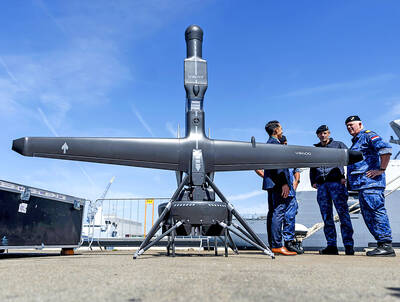
DEFENSE PROCUREMENT: Taiwan could become the largest operator of V-BAT drones outside the US once they are delivered, the Ministry of National Defense said The navy and the coast guard are acquiring 292 units of MQ-35A V-BAT vertical takeoff and landing (VTOL) surveillance drones manufactured by US-based defense technology company Shield AI, making Taiwan one of the largest buyers of the drone. The Coast Guard Administration budgeted NT$1.2 billion (US$37.1 million) to buy 12 drones, which have been delivered, Shield AI said in a report on Oct 13. The navy is planning to spend NT$36 billion under a four-year program code-named Project Yuan Xiao (遠鴞) to acquire 280 V-BAT drones, the Ministry of National Defense’s fiscal 2027 report showed. The combined procurement is expected

The government would continue monitoring online rumors that a pneumonic plague outbreak has spread from Russia into China and could enhance existing quarantine measures, Premier Cho Jung-tai (卓榮泰) said today. During a legislative meeting, Democratic Progressive Party Legislator Wang Ting-yu (王定宇) said rumors were circulating that the disease had spread across several Chinese provinces. He asked Cho whether the government was prepared to prevent the disease from spreading to Taiwan, given the frequent exchanges between Taiwan and China, and how concerned the government was about the alleged outbreak. The Ministry of Health and Welfare implemented border quarantine measures after briefing the Executive Yuan

MAYORAL RACE: Su Chiao-hui made gains by persuading undecided voters and winning over voters in KMT-leaning districts, a pollster said Legislator Su Chiao-hui (蘇巧慧), the Democratic Progressive Party’s (DPP) candidate for New Taipei City mayor, has a 13.1 percentage point lead over her Chinese Nationalist Party (KMT) rival Lee Shu-chuan (李四川), a poll released yesterday showed. The poll, commissioned by the Taipei Trust in Democracy Association, showed that 43.1 percent of respondents said they would vote for Su, up 7.9 percentage points from a poll conducted in late August, while support for Lee was at 30 percent, down 4.7 percentage points. It showed that 48.6 percent of respondents thought Su would make a suitable mayor, compared with 35.9 percent for Lee. Independent candidate

A Chinese People's Liberation Army (PLA) Navy aircraft carrier group was being monitored after entering the western Pacific, the Ministry of National Defense said today, after Beijing yesterday criticized Taiwan for using a water cannon against a Chinese fishing boat near the Pratas Islands (Dongsha Islands, 東沙群島). A Chinese naval task group led by the aircraft carrier Liaoning (遼寧) yesterday sailed to the western Pacific for training, Chinese state-run Xinhua news agency quoted the PLA Navy as saying. “The drill is part of the annual routine training plan aimed at testing and improving the troops’ combat readiness and enhancing their ability to


 RSS
RSS